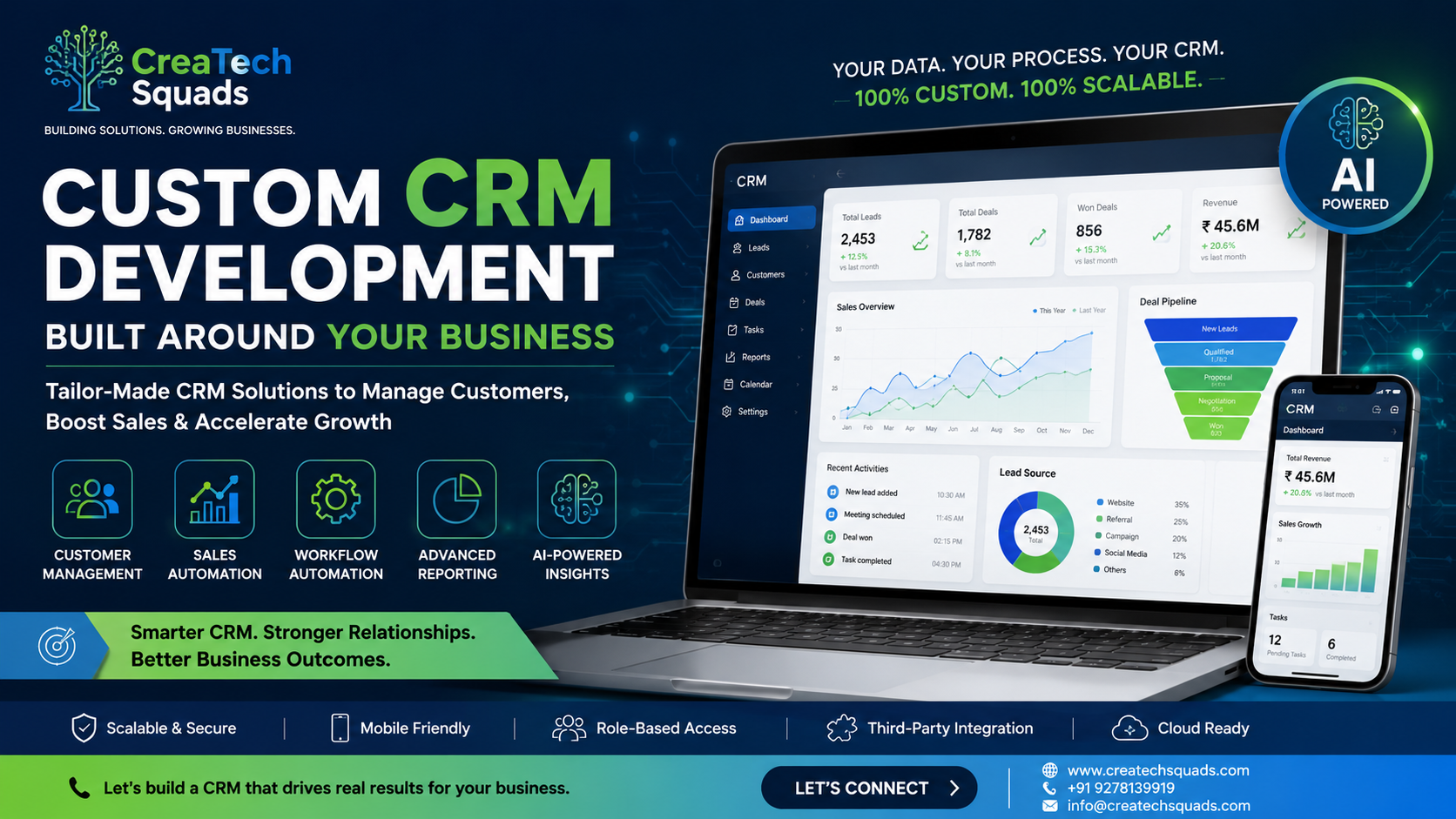
Looking for a custom CRM development company in India? Learn how a tailor-made CRM system improves sales, customer management, automation, reporting, and business growth. Discover features, pricing, implementation strategies, AI integration, and how to choose the right CRM development partner in 2026.
Custom CRM Development Company in India (2026): The Complete Guide to Building a CRM That Increases Sales, Customer Retention & Business Growth
Businesses today generate more customer data than ever before. Every enquiry, quotation, follow-up, invoice, support request, WhatsApp conversation, website lead, social media message, and phone call contains valuable information that can directly impact revenue.
Unfortunately, many businesses still manage this information using spreadsheets, notebooks, WhatsApp chats, emails, or disconnected software. As the company grows, these fragmented processes begin creating delays, missed opportunities, poor customer experiences, and declining productivity.
This is where a professionally developed Custom CRM becomes one of the most valuable investments a business can make.
Unlike ready-made CRM software that forces companies to adapt their workflows, a custom CRM is built specifically around your business operations, sales process, employees, customers, and long-term goals.
Whether you're a startup, SME, enterprise, manufacturer, healthcare provider, educational institution, real estate company, logistics firm, or service-based business, a customized CRM can transform how your organization operates.
In this comprehensive guide, we'll explain everything business owners need to know before hiring a Custom CRM Development Company in India—from features and pricing to implementation, AI integration, scalability, and return on investment.
What is Custom CRM Development?
Custom CRM development refers to designing and building customer relationship management software specifically for a company's unique workflow instead of using generic off-the-shelf software.
Every organization follows different sales cycles, approval structures, reporting requirements, customer journeys, and internal processes. A custom-built CRM adapts to these differences rather than forcing businesses to change their operations.
Instead of paying monthly subscription fees for features you never use, custom CRM software gives you complete ownership, flexibility, scalability, and control over your business data.
A Custom CRM Can Manage
Lead Management
Customer Database
Sales Pipeline
Quotation Generation
Task Management
Employee Tracking
Project Management
Invoice Management
Vendor Management
Inventory Integration
Customer Support Tickets
Marketing Campaigns
WhatsApp Communication
Email Automation
AI-based Customer Insights
Business Analytics
Why Businesses Are Moving Towards Custom CRM Solutions in 2026
Indian businesses are becoming increasingly digital. Customers now expect faster responses, personalized communication, transparent order tracking, and seamless support across multiple channels.
At the same time, business owners require accurate reports, automation, centralized customer information, and real-time performance insights.
Generic CRM platforms often become expensive as teams expand and advanced features require premium subscriptions.
Custom CRM development eliminates these limitations while allowing organizations to create software perfectly aligned with their operations.
Major Reasons Businesses Choose Custom CRM
Complete ownership of customer data
No unnecessary monthly licensing costs
Highly secure architecture
Personalized workflow automation
Scalable according to business growth
Integration with existing software
Department-specific dashboards
Role-based access controls
AI-powered automation
Higher employee productivity
Signs Your Business Needs a Custom CRM
Many companies continue operating without realizing that inefficient processes are costing them revenue every single day.
If any of the following situations sound familiar, investing in a custom CRM should become a business priority.
Business Problem CRM Solution Leads getting lost Centralized lead management with automatic assignment Delayed customer follow-ups Automated reminders and notifications Multiple Excel sheets Unified cloud-based database No sales visibility Real-time sales dashboard Manual reporting Instant business analytics Duplicate customer records Smart duplicate detection Poor communication Integrated email, WhatsApp, SMS and calling Slow approvals Automated approval workflows Scattered customer history Complete customer timeline
Essential Features Every Modern Custom CRM Should Include
A CRM is no longer just a digital contact book. Modern CRM software functions as the operational backbone of an entire organization.
1. Lead Management
Capture leads from websites, landing pages, Google Ads, Meta Ads, WhatsApp, social media, referrals, phone calls, and third-party platforms into a centralized dashboard with automatic assignment rules.
2. Sales Pipeline Management
Track every opportunity from inquiry to conversion using customizable sales stages, probability scoring, reminders, and activity history.
3. Customer Database
Maintain complete customer profiles including purchase history, communication logs, documents, invoices, support tickets, notes, and follow-up schedules.
4. Workflow Automation
Reduce repetitive manual work by automating lead assignments, follow-up reminders, email notifications, quotation approvals, invoice generation, and customer onboarding.
5. AI-Powered Insights
Artificial intelligence can identify high-conversion leads, predict customer behavior, recommend follow-up timing, detect inactive prospects, and generate business insights automatically.
6. Reports & Dashboards
Business owners should have instant access to KPIs such as revenue, conversion rates, sales performance, lead sources, employee productivity, pending follow-ups, customer retention, and monthly growth trends.
Industry-Specific CRM Development
One of the biggest advantages of custom CRM development is industry-specific customization. Instead of using generic modules, organizations can build workflows designed around their exact business model.
Industries That Benefit from Custom CRM
Real Estate
Healthcare
Education
Manufacturing
Logistics
Finance
Insurance
Travel Agencies
Legal Firms
Retail Chains
E-commerce
Construction
Hospitality
Digital Marketing Agencies
IT Companies
Each industry has unique workflows, approval processes, compliance requirements, customer journeys, and reporting structures. A custom CRM accommodates these differences while improving efficiency across departments.
Integration Capabilities That Make a CRM More Powerful
A CRM delivers maximum value when it seamlessly connects with the tools your business already uses. Instead of switching between multiple platforms, employees can work from a single centralized system.
Website Lead Forms
WhatsApp Business API
Email Platforms
SMS Gateways
Payment Gateways
Accounting Software
ERP Systems
Inventory Management
HRMS Software
Google Calendar
Microsoft 365
Cloud Storage
Telephony Solutions
E-commerce Platforms
Marketing Automation Tools
Businesses planning digital transformation often combine CRM implementation with broader automation initiatives. If you're exploring end-to-end workflow optimization, our guide on Business Automation Services explains how integrated automation can further improve operational efficiency:
Business Automation Services in India
AI-Powered CRM Development: The Future of Customer Relationship Management
Artificial Intelligence has transformed CRM software from a passive customer database into an intelligent business assistant. Modern CRM platforms no longer just store information—they analyze it, predict customer behavior, automate repetitive tasks, and help businesses make faster, data-driven decisions.
In 2026, companies investing in AI-powered CRM development are gaining a competitive advantage by reducing manual work, improving customer experiences, and increasing sales efficiency.
How AI Enhances CRM Software
Predictive lead scoring based on historical conversion patterns
Automatic follow-up reminders using customer engagement data
AI-generated email responses and communication suggestions
Smart customer segmentation for targeted marketing campaigns
Sales forecasting using machine learning algorithms
Customer churn prediction and retention recommendations
Sentiment analysis for support conversations
Intelligent reporting with actionable business insights
AI-powered chatbots for instant customer support
Automated task creation based on customer interactions
Businesses embracing AI-driven customer relationship management are not replacing employees—they are empowering sales, marketing, and support teams to focus on strategic work while automation handles repetitive activities.
Custom CRM vs Ready-Made CRM Software
Many business owners initially consider popular subscription-based CRM platforms because they are quick to implement. However, as operations expand, limitations in customization, scalability, and recurring costs often become apparent.
Feature Custom CRM Ready-Made CRM Business-specific workflows Fully customizable Limited customization Ownership Complete ownership Subscription model Monthly licensing fees No recurring license Ongoing subscription costs Third-party integrations Unlimited possibilities Depends on vendor support Scalability Designed around business growth Restricted by pricing plans Data control Business owns the data Vendor-hosted environment Performance optimization Built for specific workloads Shared platform resources Competitive differentiation Unique features possible Same functionality for competitors
While ready-made CRMs work well for some organizations, companies with unique processes, multiple departments, or rapid growth often benefit significantly from a custom-built solution.
Benefits of Custom CRM Development for Different Departments
Sales Team
Centralized lead management
Automated follow-up reminders
Pipeline visibility
Quotation tracking
Revenue forecasting
Performance dashboards
Marketing Team
Campaign tracking
Lead source analysis
Audience segmentation
Email automation
ROI measurement
Conversion reporting
Customer Support
Ticket management
Customer communication history
SLA monitoring
Knowledge base integration
Complaint tracking
Resolution analytics
Management
Executive dashboards
Department performance monitoring
Business forecasting
Financial reports
Growth analytics
Operational insights
How Custom CRM Improves Sales Performance
One of the primary reasons businesses invest in CRM software is to increase sales efficiency. Sales representatives spend less time searching for customer information and more time building relationships that generate revenue.
A modern CRM streamlines the entire customer acquisition process—from capturing leads and assigning them to the appropriate salesperson to tracking every interaction and identifying the next best action.
Automated workflows ensure no opportunity is overlooked. Managers gain complete visibility into pipeline health, conversion rates, and team performance, enabling proactive decision-making instead of reactive management.
Sales Benefits
Faster response times
Higher lead conversion rates
Reduced follow-up delays
Better customer engagement
Improved sales forecasting
Accurate performance tracking
Higher average deal size
Increased customer retention
CRM Security: Protecting Business-Critical Data
Customer information is among the most valuable assets any organization possesses. A professionally developed CRM should incorporate enterprise-grade security practices that protect sensitive business data while ensuring authorized users have secure access.
Essential Security Features
Role-based user permissions
Multi-factor authentication (MFA)
Encrypted data transmission
Encrypted database storage
Audit logs
IP-based access restrictions
Regular automated backups
Disaster recovery planning
Session timeout controls
Secure API authentication
Businesses handling confidential customer information should also ensure compliance with applicable data privacy regulations and adopt secure development practices throughout the CRM lifecycle.
Custom CRM Development Process
Successful CRM implementation requires more than software development. It begins with understanding business processes and continues through deployment, employee training, and ongoing optimization.
Business process analysis
Requirement gathering workshops
Workflow mapping
UI/UX wireframing
Database architecture planning
CRM development
Third-party integrations
Quality assurance testing
User acceptance testing
Deployment
Employee onboarding
Ongoing maintenance and feature enhancements
A structured implementation approach minimizes operational disruption while ensuring the CRM aligns closely with existing business processes.
Choosing the Right Custom CRM Development Company in India
Selecting the right development partner has a significant impact on the long-term success of your CRM project. Beyond technical expertise, businesses should evaluate an agency's understanding of business operations, scalability, security, and post-launch support.
What to Look For
Experience developing custom CRM platforms
Business workflow consulting capabilities
Strong UI/UX design expertise
API integration experience
Cloud deployment knowledge
Security-first development practices
Scalable architecture
Transparent project management
Post-launch maintenance and support
AI integration capabilities
Businesses planning a complete digital ecosystem often combine CRM implementation with custom ERP systems, website development, and mobile applications. Choosing a technology partner capable of delivering these integrated solutions can simplify operations and reduce long-term costs.
For organizations evaluating enterprise-grade ERP and CRM solutions, explore our comprehensive guide:
Best ERP & CRM Development Company in India
How Much Does Custom CRM Development Cost in India?
One of the most common questions business owners ask is, "How much does it cost to build a custom CRM?" The answer depends on the scope of the project, number of users, required modules, third-party integrations, security requirements, AI capabilities, and future scalability.
Unlike subscription-based CRM platforms where businesses continue paying monthly licensing fees, a custom CRM is a long-term digital asset that can be enhanced as the organization grows.
Rather than selecting a solution based solely on initial cost, companies should evaluate the long-term return on investment, operational efficiency, employee productivity, and customer satisfaction improvements the system will deliver.
Factors That Influence CRM Development Cost
Number of user roles and departments
Complexity of workflows and approval processes
Cloud or on-premise deployment
Mobile application requirements
Third-party integrations
AI-powered automation features
Reporting and analytics dashboards
Document management capabilities
Data migration from existing systems
Security and compliance requirements
Post-launch support and maintenance
Think Beyond Initial Cost
A professionally developed CRM helps reduce operational costs, increase employee efficiency, improve customer retention, shorten sales cycles, and provide better visibility into business performance. These long-term benefits often deliver significantly greater value than the initial development investment.
Common Mistakes Businesses Make When Developing a CRM
Many CRM projects fail—not because of technology—but because of poor planning, unclear objectives, and inadequate user adoption. Understanding these common mistakes can help businesses avoid costly delays and ensure successful implementation.
Building software without analyzing business workflows
Trying to automate inefficient manual processes
Ignoring employee feedback during planning
Adding unnecessary features that increase complexity
Not planning for future scalability
Choosing technology based only on price
Skipping user training
Poor data migration from legacy systems
Ignoring security and backup planning
Failing to integrate existing business applications
A successful CRM should simplify operations rather than create additional administrative work. The focus should always remain on improving business productivity and customer experience.
Future Trends in CRM Development
Customer relationship management continues to evolve rapidly. Businesses investing in CRM software today should choose a platform that can adapt to future technological advancements without requiring a complete rebuild.
Emerging CRM Trends in 2026 and Beyond
AI-powered sales assistants
Voice-enabled CRM interactions
Predictive customer analytics
Hyper-personalized customer engagement
Low-code workflow automation
Integrated business intelligence dashboards
Omnichannel communication management
Generative AI for customer support
Advanced cybersecurity protections
Real-time executive reporting
IoT-enabled customer service workflows
Industry-specific CRM ecosystems
Organizations that invest in scalable, future-ready CRM architecture today will be better positioned to adopt new technologies without disrupting business operations.
Why Choose CreaTech Squads for Custom CRM Development?
At CreaTech Squads, we build business-focused CRM solutions that align with your unique workflows, operational goals, and long-term growth strategy. Instead of delivering generic software, we create intelligent CRM platforms that improve efficiency, automate repetitive tasks, and provide actionable business insights.
Our development approach combines modern technologies, intuitive user experiences, secure architecture, and scalable infrastructure to ensure your CRM evolves with your business.
What We Deliver
Business workflow analysis
Custom CRM architecture and development
Role-based dashboards
Lead and sales management modules
Customer support systems
AI-enabled automation
WhatsApp, email, SMS, and API integrations
ERP integration
Cloud deployment
Mobile-friendly CRM solutions
Comprehensive reporting dashboards
Long-term technical support and maintenance
Our goal is not simply to develop software—but to help businesses improve productivity, strengthen customer relationships, and accelerate sustainable growth through technology.
Related Resources
If you're planning a broader digital transformation, these resources may also help:
Frequently Asked Questions (FAQs)
1. What is the biggest advantage of a custom CRM over ready-made software?
A custom CRM is designed around your business processes, allowing greater flexibility, ownership, scalability, and integration compared to generic subscription-based CRM platforms.
2. Can a custom CRM integrate with WhatsApp and email?
Yes. Modern CRM solutions can integrate with WhatsApp Business APIs, email platforms, SMS gateways, telephony systems, payment gateways, ERP software, and many other business applications.
3. Is custom CRM suitable for small businesses?
Absolutely. Small and medium-sized businesses benefit from streamlined operations, centralized customer management, automated follow-ups, and scalable software that grows alongside the company.
4. How long does custom CRM development take?
The timeline depends on project complexity, required modules, integrations, testing, and deployment. A well-planned implementation ensures better long-term success than rushing development.
5. Can AI be integrated into a CRM system?
Yes. AI can automate lead scoring, sales forecasting, customer segmentation, workflow automation, chatbot support, predictive analytics, and business reporting.
6. Is a cloud-based CRM better than an on-premise solution?
Cloud-based CRM systems provide easier scalability, remote accessibility, automatic backups, and simplified maintenance. However, organizations with strict compliance or infrastructure requirements may choose on-premise deployment.
Conclusion
Customer expectations continue to evolve, and businesses that rely on disconnected systems or manual processes risk losing valuable opportunities. A custom CRM provides a centralized platform for managing leads, nurturing customer relationships, automating workflows, improving collaboration, and making informed business decisions.
Whether you're a growing startup or an established enterprise, investing in a scalable CRM solution can significantly improve operational efficiency and long-term profitability.
If you're looking for a trusted Custom CRM Development Company in India, CreaTech Squads delivers tailored CRM solutions built around your business—not the other way around. From planning and development to AI integration and ongoing support, we help organizations build future-ready customer relationship management systems that drive measurable business growth.
"A CRM shouldn't just store customer data—it should empower your business to build stronger relationships, automate repetitive work, and make smarter decisions every day."

Comments (0)
Loading comments...